
Why Most Managers Grade Their Roster Wrong
Your record lies to you. That is the first problem. A 6-3 team that played the three weakest schedules in the league is not a contender — it is a lucky team. A 4-5 team that lost four games by less than five points, against the four best teams, might be closer than its record says. Wins are a small sample. Points-for is the bigger one: it measures what your roster actually produced, week after week, no matter who you happened to play. Footballguys calls projected record "the clearest indicator" of championship chances, and they are right about the idea — but your record so far is not your projected record. Look at points-for first, then wins.
The second problem is love. You drafted these players. You watched them break out. You traded for them when everyone else had given up. That history makes every player on your roster feel like a keeper, and it makes every hole feel small. A manager in love with his own roster grades his WR3 as a future WR1 and his ageing running back as "still got a year left". He does not. The scorecard below is built to beat that bias: it asks for numbers, not feelings, and it asks them in an order that leaves no room for a favourite player to hide.
The third problem is the "one last run". Every middle team tells itself the same story: we were close last year, one more piece and we are there. RotoWire's rebuild guide names the trap plainly — do not do "one last run after the one last run". A roster that needed one last run last season, and the season before that, is not one piece away. It is a rebuilding roster that has been spending its future for two years to stay in the middle. The grade below ends that story, one way or the other.
Dynasty Rebuild Strategy: The 5-Test Roster Grade
Test 1 — Your Starters vs a Typical Lineup
Take your best starting lineup and compare it with a typical one. TradeValues runs the only quantified version of this test in the guides we read: its team rater compares your best lineup's value with a typical 12-team lineup, and its bands are simple — a lineup worth more than 105% of a typical one this season is a contender, under 95% is a rebuilder, and in between is the same 5% band its calculator calls fair. Those bands are TradeValues' method, dated 23 November 2026, on its own scale — not Dynastyzer's numbers, and not a verdict by themselves. A typical Superflex lineup on that same date was worth 21,882 on TradeValues' scale. The same asset shows why the window matters: Christian McCaffrey was worth 3,239 on the balanced scale, 4,072 to a contender and 2,406 to a rebuilder, all on TradeValues' 23 November 2026 Superflex values. Same player, three prices — because the window changes what he is worth to you.
If you do not use a calculator, the plain version works too. Would your starting lineup, player for player, beat most lineups in your league? If you would back it against eight of the other eleven teams, that is a pass. If you would back it against three, that is a fail. Borderline is everything in between — and borderline, as you will see, is where the trouble starts.
Test 2 — How Many Difference-Makers Do You Have?
A difference-maker is a player who wins you a week by himself: roughly a top-12 player at his position, the kind of name the other manager has to plan around. Count yours. A contender usually has four or five. A rebuilder has one or none. The number matters more than the names, because one star cannot carry a lineup and two stars cannot carry a bench.
This test also catches the most common self-deception in dynasty: counting depth as difference. Five good flex players are not five difference-makers. They are five players who score well on your bench and sit there every Sunday. If your roster is deep and top-light, you are not a contender with a depth problem. You are a middle team with a bench problem — and the fix is Day 6's move, consolidating depth into a star, not another good flex.
Test 3 — The Age of Your Core
Age is the test managers skip because it hurts. Dynasty Nerds publish the clearest sell-by lines in the guides we read, and they are worth knowing even if you never sell: quarterbacks hold value until about 32, running backs start to slide at 27, wide receivers peak around 22 to 26 and should be sold at 27 or 28 while their value is still high, and tight ends peak around 25 to 29 with a sell point near 28. Those are Dynasty Nerds' thresholds, from their July 2026 guide — use them as lines on a chart, not as laws of nature. A 28-year-old running back is not worthless. He is just a player whose price will fall faster than his points will.
Now look at your core — your eight or nine best players — and count how many sit past those lines. Footballguys' example roster in their lifecycle guide had six players aged 20 to 25, twelve aged 26 to 30, and three aged 31 and over. That shape is a team with a window: young enough to last, old enough to win now. If most of your core is already past the sell-by lines, your window is not open. It is closing, and every week you wait, the players you would sell get cheaper.
Test 4 — The Picks in Your Hand
Test 5 — Points-For vs the League
This is the test your record was hiding. Rank your team by points-for, not by wins. A 5-4 team with a bottom-three points-for total is a pretender — our own trade-deadline playbook makes that exact point, and it is the reason this test sits last: it is the one that catches the team the other four tests missed. If your points-for says you are the eighth-best team in a twelve-team league, you are the eighth-best team, whatever your record says. The playoffs might still take you. The title will not.
Run the five tests, then count the passes. Four or five passes: you are a contender. Zero or one: you are a rebuilder. Two or three: you are in the middle — and the middle is the subject of the next section but one. Write the grade down. A grade you can see is harder to argue with than a feeling you can keep.
| Test | Contender | Rebuilder |
|---|---|---|
| Starters vs a typical lineup | Worth more than 105% of a typical 12-team lineup | Worth under 95% of a typical lineup |
| Difference-makers | Four or five top-12 players at their position | One or none |
| Core age | Most of the core inside the sell-by lines | Most of the core past the sell-by lines |
| Picks in hand | Few picks left — already spent on the window | Early firsts in each of the next two drafts |
| Points-for vs the league | Top four in points-for | Bottom four in points-for |
💡 The Grade Rule
Score all five tests before you trade. One strong test does not save a roster that fails the other four, and one weak test does not condemn a roster that passes the rest. The pattern is the grade.
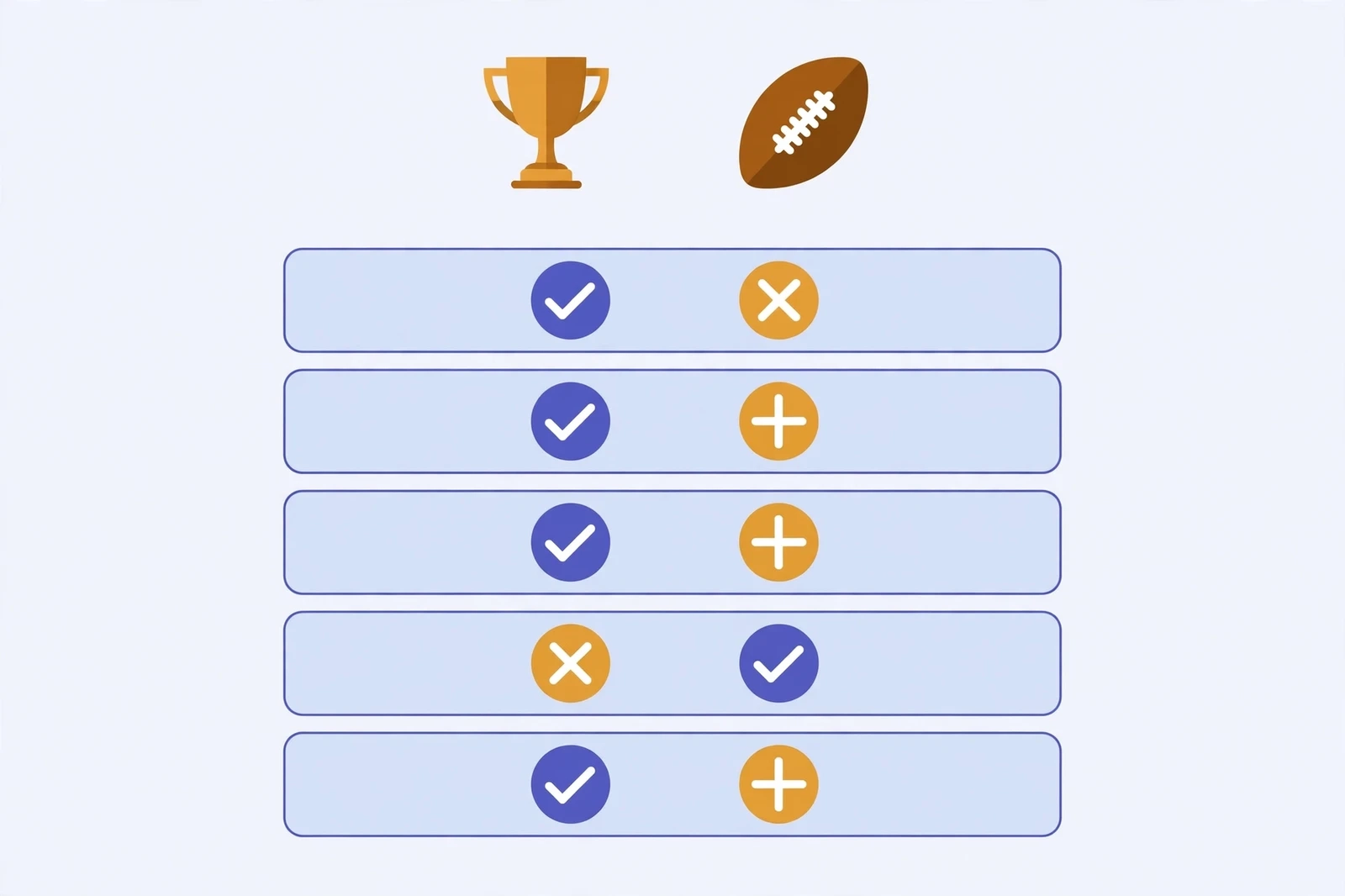
Grade 1 — Contender: What "Win Now" Actually Means
The one rule for contenders is: do not hedge. A contender who keeps one foot in the future loses in the semi-final — our own deadline playbook says so, and every contender guide agrees. Hedging looks like keeping a first-round pick "just in case" while your starting running back is a flex player. That pick will not score you points in the playoffs. The veteran it could buy might. Your window closes faster than you think: players age, injuries happen, and a roster that was a contender in November can be a middle team by March. If the grade says win now, win now.
Grade 2 — Rebuilder: What "Build" Actually Means
A rebuilder sells points and buys time. That means selling veterans before the decline is obvious — while they are still producing, while other managers still want them, and while their price still reflects their points rather than their age. Dynasty Nerds' timing rule is the one to follow: the best times to sell a veteran are in-season while he is producing, early in the season when a 0-4 team panics, and around the trade deadline. A veteran you hold one season too long is a veteran you give away.
The honest timeline is two to three years, not a punishment. RotoWire's rebuild guide tells the story of the author's own team: he blew up a third-place side in 2021, went 0-14 in 2022, made the playoffs in 2023 and won the league in 2024. That is his story, not a promise — but it is the shape a real rebuild takes. Playoff competition in two years is possible. The real target is the third and fourth seasons. And one rule of conduct, from the same guide: trade your best players, do not bench them. Weakening your lineup on purpose by sitting starters hurts the league and your reputation. Agree the tanking rules with your league mates first, and let the trades do the losing.
Grade 3 — The Middle: The Worst Place in Dynasty
Good enough for the playoffs, not good enough to win, and picking in the middle of every draft. That is the middle, and every guide we read agrees it is the worst place in dynasty. LeagueStation puts it plainly: the worst place to be is the muddled middle. SportsMonkie says the same, and Yards Per Fantasy is blunter still — a middle-of-the-pack team is just donating its yearly buy-in. A middle team does not win titles and does not get early picks. It gets the eighth pick every year, forever.
There are only two honest ways out, and both start with admitting where you are. Push in, if you are genuinely one piece away — one difference-maker, not three, and the tests above prove it. Or tear down, if you are not — sell the veterans while they still have value, collect the picks, and start the two-to-three-year clock. What you cannot do is stay. Staying feels safe because nothing changes, and nothing changing is exactly the problem. Pick a lane. The middle is not a lane. It is a waiting room with a buy-in.

The Retool: The Honest Exception
There is one exception, and it has a test. A retool is a contender with one or two holes and a young core: you stay competitive while getting younger, swapping an ageing starter for a younger one at the same position, or trading a pick for a player who fills the single gap. It works when the core is young enough that the window stays open while you fix the holes.
The test that separates a retool from self-deception is the hole count. One or two holes, and you can retool. Three or more, and you are not retooling — you are a middle team telling itself a nicer story. Count the holes honestly. If you need a starting running back, a starting wide receiver and a tight end, no single trade fixes that. That is a rebuild with a retool label on it. Take the label off, pick the lane, and get on with it.
When to Re-Grade Your Roster
A dynasty rebuild strategy is a living verdict, not a tattoo. Re-grade it at three checkpoints, and let the new grade change your mind.
The first month of the season is the first checkpoint. PFF's contender/rebuilder guide says it plainly: timing is not everything, it is the only thing, and the first month is when you first learn whether your roster is what you thought it was. If your projected contender is 1-3 with a bottom-five points-for total, the grade has already changed. Admit it in October, not in December when your veterans are worth half as much.
The offseason is the third checkpoint, and it is when a rebuild should start. If the grade says rebuild, start in January, not in September — picks are at their most valuable from January to May, your veterans are still fresh in other managers' minds, and you have the whole offseason to collect young players at a discount. RotoWire's warning applies here too: do not do one last run after the one last run. If the grade says rebuild in January, rebuild in January.
A Quick Checklist Before You Trade
- Is my grade written down — contender, rebuilder, or middle — and is it based on the five tests, not on how I feel about my team?
- Does this trade move me toward my grade's timeline — win now, or build for two to three years?
- If I am a contender, does it buy me points I will actually play this season?
- If I am a rebuilder, does it buy me picks or young players, and is the veteran I am selling still producing?
- If I am in the middle, have I picked a lane first — or am I trading to stay comfortable?
- When will I re-grade — first month, deadline, offseason — and what would make me change my mind?
FAQ
How do I know if I should rebuild or contend in dynasty?
Run the five tests: starters against a typical lineup, difference-makers, core age, picks in hand, and points-for against the league. Four or five passes means contend. Zero or one means rebuild. Two or three means you are in the middle, and the middle is the worst place to stay — pick a lane.
What is the worst place to be in dynasty?
The muddled middle: good enough to make the playoffs, not good enough to win, and picking in the middle of every draft. A middle team does not win titles and does not get early picks. The only way out is to push in if you are one piece away, or tear down and rebuild if you are not.
How long does a dynasty rebuild take?
Plan for two to three years. Playoff competition in two years is possible, and the real target is usually the third and fourth seasons. A rebuild is a plan with a timeline, not a punishment — sell veterans while they produce, collect picks and young players, and fix running back last.
When should I sell an aging veteran?
Before his age catches up with his price, if you are rebuilding. The best times are in-season while he is producing, early in the season when a winless team panics, and around the trade deadline. A veteran held one season too long is a veteran given away.
Can a middle-of-the-pack team contend?
Only if it is genuinely one piece away — one difference-maker, proven by the five tests, not by hope. If it needs two or three starters, it is not a contender. It is a middle team, and the honest move is to pick a lane: push in for real, or tear down and rebuild.
A dynasty rebuild strategy is not a set of trades. It is a verdict, reached honestly, before the trades start. Grade your roster with the five tests, write the grade down, and let it decide your lane. Contenders buy points and sell time. Rebuilders sell points and buy time. The middle does neither, and pays for it every year. Your roster already knows which one it is. Now you do too.
Grade Your Roster With the Calculator
Run your best lineup through the free Dynasty Trade Calculator and see how it stacks up against a typical lineup — then check the other four tests before you trade.